Research Focus
My research interest lies in building a more complete understanding of our current and future terrestrial gravitational-wave observatories to better make predictions about the early Universe. To achieve this, I have spent over a year living at the LIGO Hanford Observatory with the generous support of the LIGO Visitors Program in order to identify and mitigate sources of environmental coupling between the detector and its local environment using a network of auxiliary sensors distributed around the facility. Drawing on my hands-on experience at LIGO, I led the development of a software package which identifies possible instances of environmental noise in gravitational wave strain data which are also seen by this auxiliary sensor network. Such noise, if unnoticed and unmitigated, could introduce errors in the physics we infer from compact binary mergers, such as nuclear astrophysics, cosmic expansion, or constraints on Beyond the Standard Model theories. Each of the 250+ significant gravitational wave candidates listed here has been examined by my software for possible environmental noise contamination as part of its integration with LIGO's low-latency detection computing infrastructure. I also currently lead the LIGO-Virgo-KAGRA Collaboration's search for gravitational wave transients—bursts—from cosmic strings. These objects, formed by spontaneous symmetry breaking in the early Universe, should produce intense bursts of gravitational radiation. However, their appearance in LIGO detector data closely resembles that of a known class of glitches, and my work is ongoing to come up with methods to differentiate between gravitational waves and detector noise in the case of a potential cosmic string detection.
At present, a majority of my time is spent developing environmental noise calculations for optical simulations for Next Generation gravitational wave detectors, namely Cosmic Explorer. Over 99% of the facility will be a LIGO-style beamtube, with baffles to mitigate noise from scattered light affecting the gravitational wave data. The design and placement of these baffles is still uncertain. I am developing a proposal for scattered light mitigation for Cosmic Explorer's beamtube which optimizes both scattered light noise and construction cost and complexity.
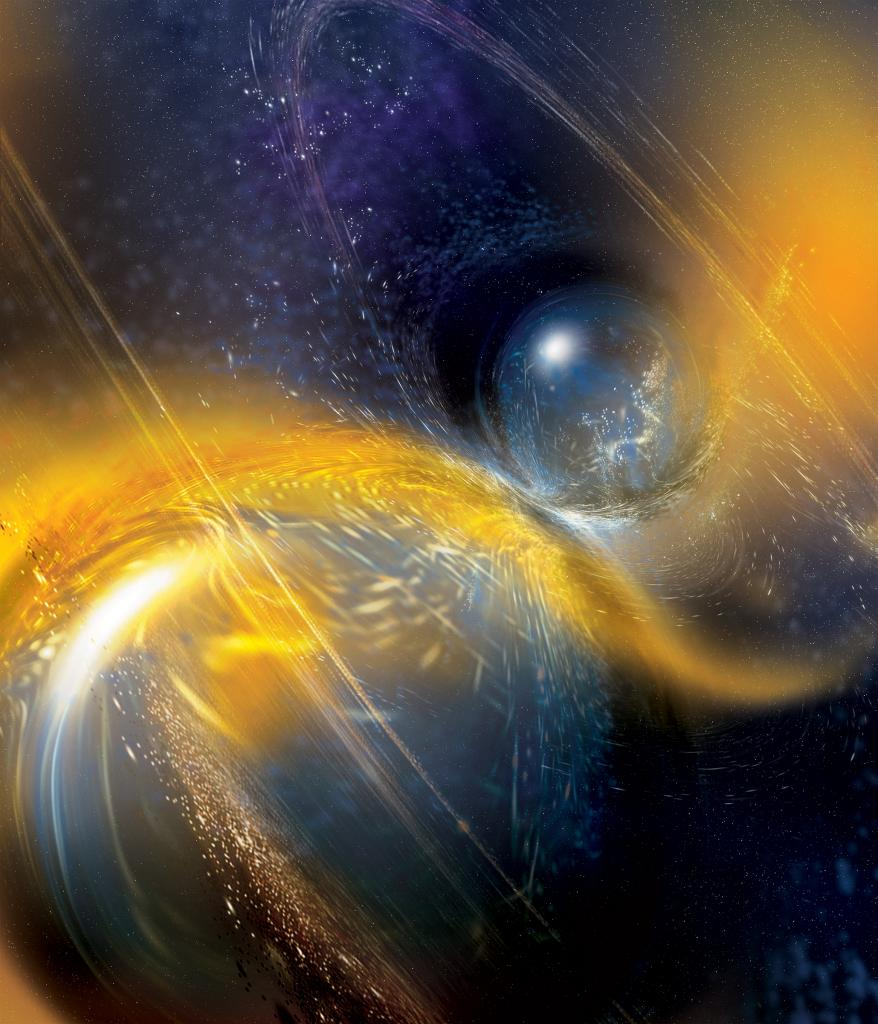 Image credit: National Science Foundation/LIGO/Sonoma State University/A. Simonnet.
Artist's rendition of GW190425: the first compact binary colaescence detected after I began gravitational wave research with LIGO. You can view a handy breakdown of the merger's properties at the factsheet shown here, which I designed.
Image credit: National Science Foundation/LIGO/Sonoma State University/A. Simonnet.
Artist's rendition of GW190425: the first compact binary colaescence detected after I began gravitational wave research with LIGO. You can view a handy breakdown of the merger's properties at the factsheet shown here, which I designed.